SEO-friendly
For website-style products, strong search engine rankings can bring a steady stream of organic traffic. In the past, many teams relied on SEM (paid ads) to appear at the top of search results—but you can absolutely win without paying, by doing SEO well.
useSeoMeta({
  title: pageTitle,
  description: pageDescription,
  ogTitle: pageTitle,
  ogDescription: pageDescription,
  ogImage: computed(() => post.value?.imageUrl || '/og-image.jpg'),
});
NuxtPro is built on Nuxt SSR and integrates SEO optimization deeply across pages—from structure and headings to keyword distribution, internal/external linking, OG, and Meta tags.
useHead({
  link: [
    { rel: 'canonical', href: config.public.baseUrl || 'https://nuxtpro.com' }
  ]
})const metaTitle = 'Blog | OpenSource Nuxt SaaS Boilerplate | NuxtPro'
const metaDescription = 'The NuxtJS boilerplate with all the stuff you need to get your product in front of customers. From idea to production in 1 hour.'From day one (your MVP launch), this helps you climb rankings and keep traffic coming.
useSeoMeta({
  twitterCard: 'summary_large_image',
  twitterTitle: metaTitle,
  twitterDescription: metaDescription,
  twitterSite: config.public.baseUrl || 'https://nuxtpro.com',
  twitterImage: '/twitter-image.jpg'
});
SEO tools
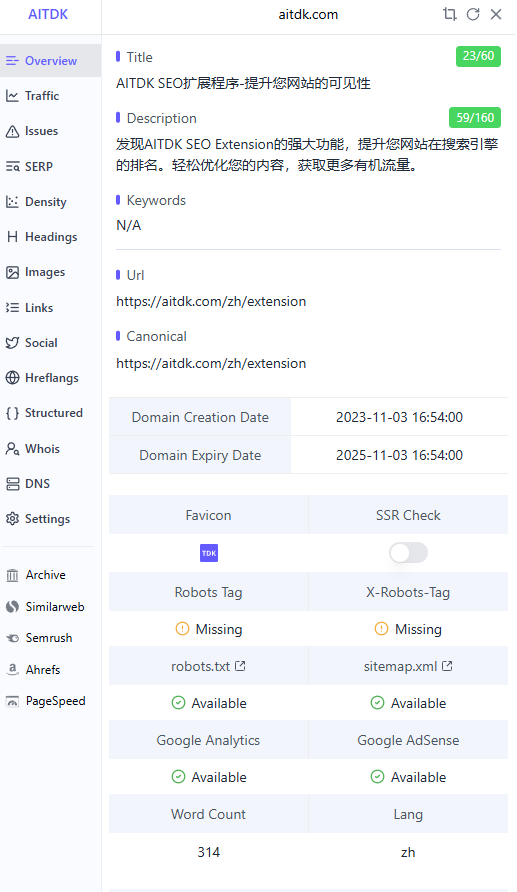
A good SEO tool can speed up ranking improvements and help you spot issues to avoid penalties.
Recommended browser extension: AITDK. It’s great for analyzing SEO signals and adjusting keyword strategy.
Add robots.txt
Add a robots.txt so crawlers can discover (and avoid) the right paths:
User-agent: *
Disallow: /admin/
Disallow: /user/
Disallow: /tmp/
Disallow: /logs/
Disallow: /config/
Disallow: /scripts/
Disallow: /search/
Disallow: /*.pdf$
Add sitemap.xml
Add a sitemap.xml so search engines can understand your site structure better:
<?xml version='1.0' encoding='utf-8' standalone='yes'?>
<urlset xmlns="http://www.sitemaps.org/schemas/sitemap/0.9">
  <url>
    <loc>https://nuxtpro.com/</loc>
    <lastmod>2025-07-08</lastmod>
  </url>
</urlset>